Smart trade, not blanket tariffs.
Tariffs should protect Americans — not tax them.
The Majority supports targeted tariffs when necessary to protect American jobs, national security, and critical industries. But broad tariffs that increase costs for American families and businesses should not be used as a substitute for a smart trade policy.
The polling on tariffs is unusually consistent.
Most issues move around depending on the week and the wording. Tariffs mostly don't. The freshest national read is an Economist/YouGov poll conducted August 14–17, 2026, which asked what should happen to tariffs on foreign goods: 49% said decrease, 24% said keep them where they are, and just 14% said increase. Americans favor cutting tariffs over raising them by 35 points.
That isn't a one-poll blip. Pew's January 2026 national survey found 60% disapproved of substantially increasing tariffs against 37% who approved — and Pew's tracking shows that number sitting near 60–61% all the way back to April 2025. A later Pew survey found 63% had little or no confidence in how tariff policy was being handled.
The independent numbers are where this stops being interesting and starts being decisive. Navigator found 63% of independents opposed the tariff plan in April 2026 against just 21% supporting it, and a separate 2026 Navigator survey put independents viewing tariffs unfavorably at 69%.
Marquette found 69% of independents favored limiting the president's tariff authority. Gallup found only 31% of independents believed tariffs would produce a net financial benefit to the country in the long run.
The 60% test
TheMajority.us doesn't call something a majority position on one poll. Every tariff proposition below clears 60% in a high-quality national survey.
| Tariff proposition | National result | Clears 60%? |
|---|---|---|
| Disapprove of substantially increasing tariffs | 60% disapprove | ✅ |
| View tariffs unfavorably | 60% unfavorable | ✅ |
| Limit presidential authority to impose tariffs | 63% limit it | ✅ |
| Little or no confidence in the president’s tariff decisions | 63% lack confidence | ✅ |
| Tariffs will cost the U.S. more than they generate, long term | 62% agree | ✅ |
| Tariffs will cost the U.S. more than they generate, short term | 70% agree | ✅ |
| Tariffs will result in higher prices | 89% agree | ✅ |
| Tariffs will lead to higher prices | 73% agree | ✅ |
History has already run this experiment.
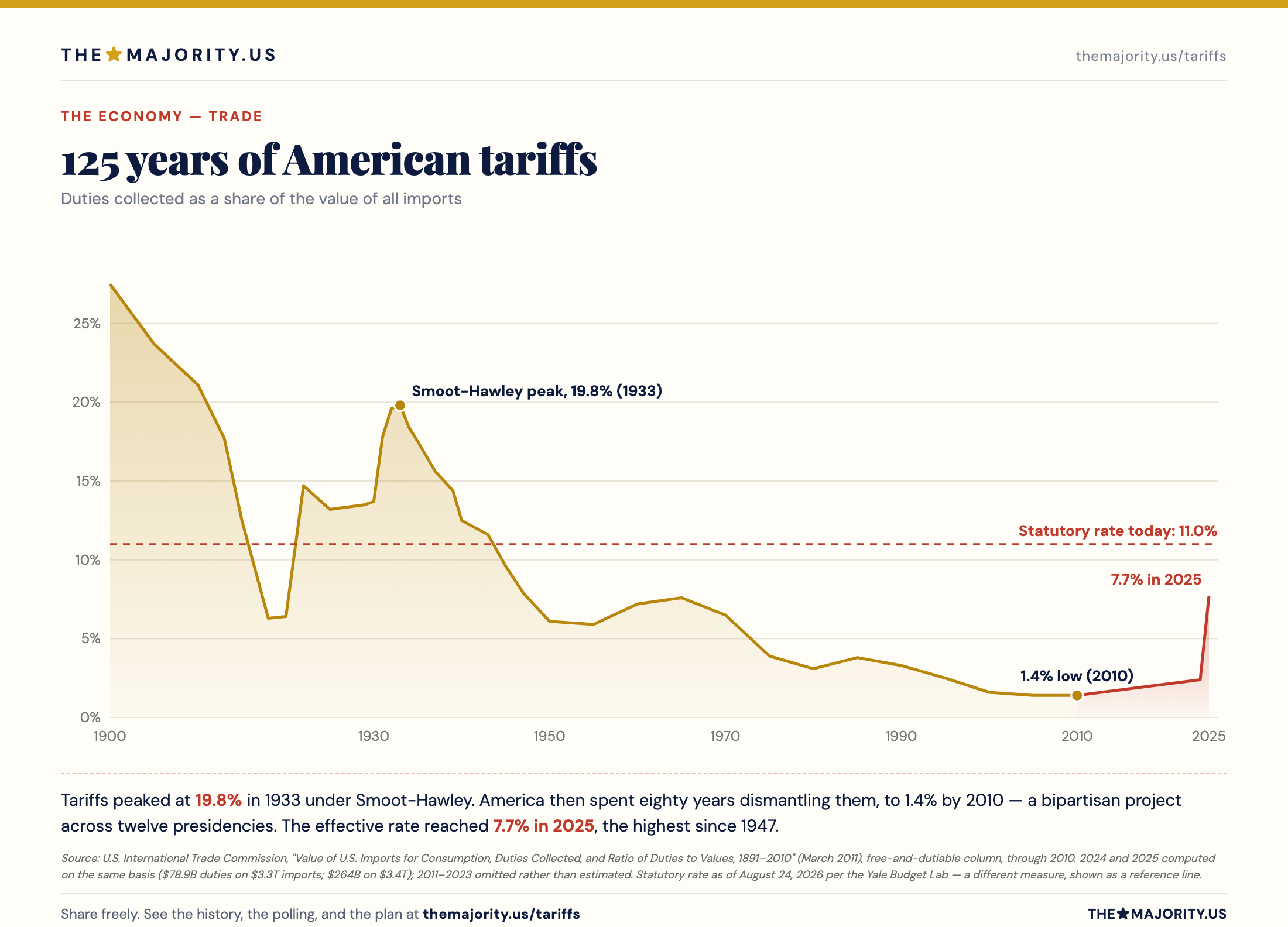
The best-known case is Smoot-Hawley. In May 1930, weeks before passage, 1,028 economists signed a petition asking President Hoover to veto it. He signed it instead. Canada and others retaliated, and world trade fell by roughly two-thirds between 1929 and 1934.
We should be careful with that one, because the honest version is more useful than the slogan. Modern economic historians do not think Smoot-Hawley caused the Depression — the collapse in output and incomes drove most of the trade decline, with tariffs and retaliation commonly credited with something like a fifth to a quarter of it. Smoot-Hawley didn't start the fire. It poured gas on it. That is the actual lesson, and it's the one worth carrying.
Forty years earlier the McKinley Tariff pushed average duties to nearly 50%. Weeks later, Republicans lost the House in one of the worst routs in the party's history — from 171 seats down to 88 — and the White House two years after that. Voters have punished broad tariffs before.
The most rigorous evidence is also the most recent. Federal Reserve economists studied the 2018–19 tariffs and separated the three things a tariff does at once. Moving an industry from lightly to heavily exposed produced a 0.4% employment gain from import protection — and then a 2.0% loss from higher input costs and a 1.1% loss from retaliation. The protection was real. It was just much smaller than the bill that came with it.
Farmers paid the retaliation directly. Agricultural exports fell $27 billion from mid-2018 through 2019, soybeans making up 71% of the loss, and Washington sent $28 billion in payments to cover it. A tariff that requires a bailout to offset its own retaliation is not a policy that paid for itself.
“At first, when someone says, ‘Let's impose tariffs on foreign imports,’ it looks like they're doing the patriotic thing by protecting American products and jobs.”
“High tariffs inevitably lead to retaliation by foreign countries and the triggering of fierce trade wars… Markets shrink and collapse; businesses and industries shut down; and millions of people lose their jobs.”
The other country always gets a turn.
A tariff is debated at home as though it were a decision America makes alone. It never is. Every round below was answered — and the answer is chosen to hurt, aimed at the exports with the most political weight behind them.
- 1930Canada raised duties on American goods within months, and roughly two dozen other countries followed. World trade fell about two-thirds in four years.
- 1964The “chicken tax” was itself the retaliation — America answering European duties on US frozen chicken. Retaliation is how that tariff was born, and 60 years later it is still collected.
- 2002The EU drew up $2.2 billion of American exports to hit and picked the targets politically: Florida citrus, Wisconsin-built Harley-Davidsons. Bush withdrew the steel tariffs a year early.
- 2018China put 25% on American soybeans. Farm exports fell $27 billion, soybean sales to China dropped from $12.8 billion a year to $4.7 billion, and Washington paid $28 billion in bailouts to cover the hole.
Four rounds, four retaliations. There is no example on this page of a broad American tariff that went unanswered.
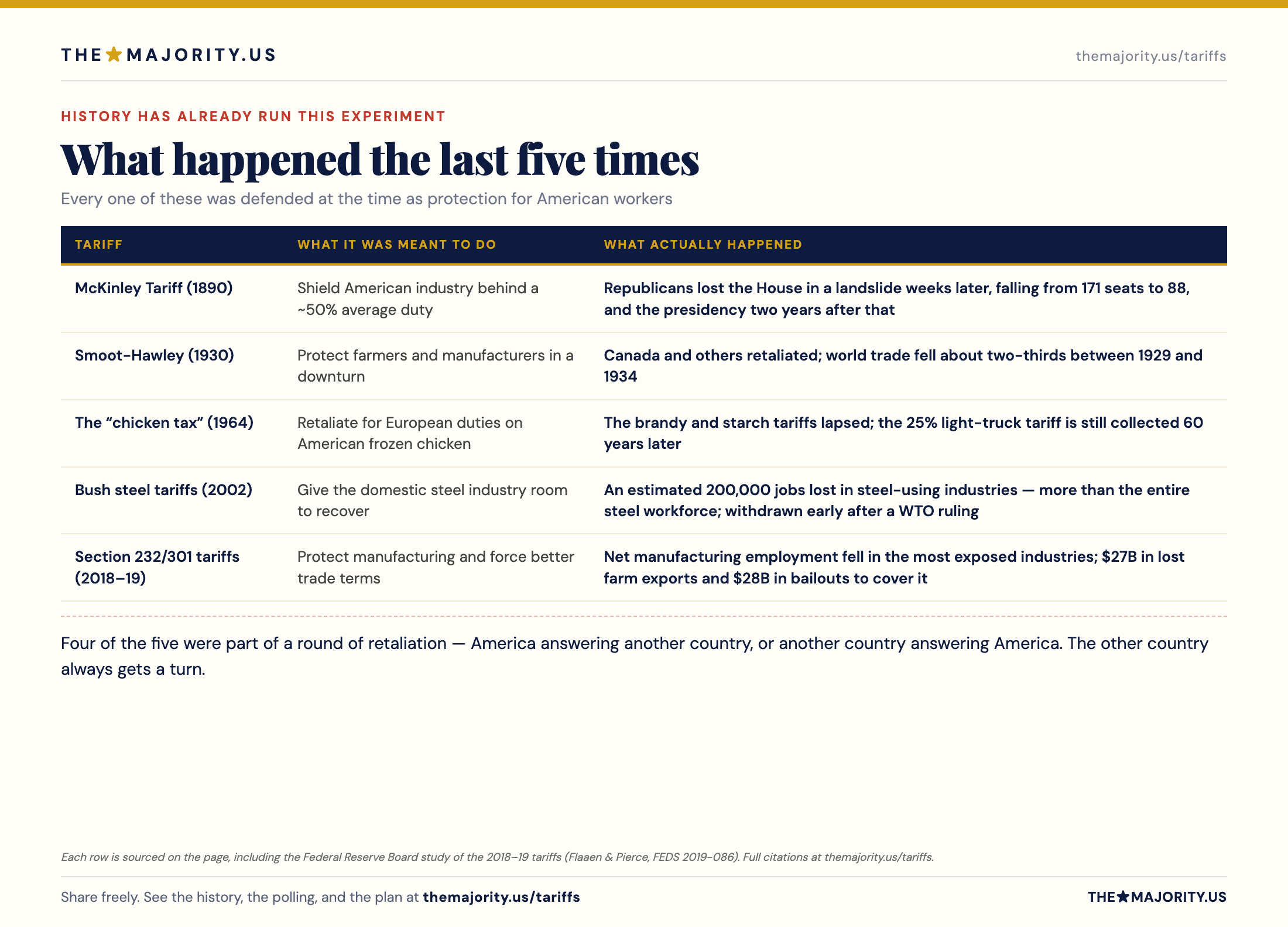
What happened the last five times
Every one of these was defended at the time as protection for American workers.
| Tariff | What it was meant to do | What actually happened |
|---|---|---|
| McKinley Tariff (1890) | Shield American industry behind a ~50% average duty | Republicans lost the House in a landslide weeks later, falling from 171 seats to 88, and the presidency two years after that |
| Smoot-Hawley (1930) | Protect farmers and manufacturers in a downturn | Canada and others retaliated; world trade fell about two-thirds between 1929 and 1934 |
| The “chicken tax” (1964) | Retaliate for European duties on American frozen chicken | The brandy and starch tariffs lapsed; the 25% light-truck tariff is still collected 60 years later |
| Bush steel tariffs (2002) | Give the domestic steel industry room to recover | An estimated 200,000 jobs lost in steel-using industries — more than the entire steel workforce; withdrawn early after a WTO ruling |
| Section 232/301 tariffs (2018–19) | Protect manufacturing and force better trade terms | Net manufacturing employment fell in the most exposed industries; $27B in lost farm exports and $28B in bailouts to cover it |
Not anti-tariff. Anti-blanket-tariff.
It would be easy — and wrong — to read those numbers as “60% of Americans oppose tariffs.” We won't make that claim, because the evidence doesn't support it. Stanford's Public Pulse reviewed 39 tariff questions across eight nationally representative surveys and concluded that Americans lean more negative than positive on tariffs — but that support moves substantially depending on how the question is framed.
What voters are consistently against is the cost. Gallup found 89% expected tariffs to raise prices. Ipsos found 73% expected higher prices and only 35% thought tariffs were worth it. Navigator found 65% of independents said tariffs had already increased their own costs.
So the honest majority position isn't “end tariffs.” It's narrower and it holds up: oppose broad, across-the-board tariffs that function as a tax on American consumers and businesses — and keep targeted tariffs available for dumping, strategic industries, and countries that break trade rules.
That is the same economic-freedom argument that runs through everything else here. Protect American businesses without needlessly raising their input costs. A tariff on a component an American factory has to import isn't protection — it's a tax on the factory.
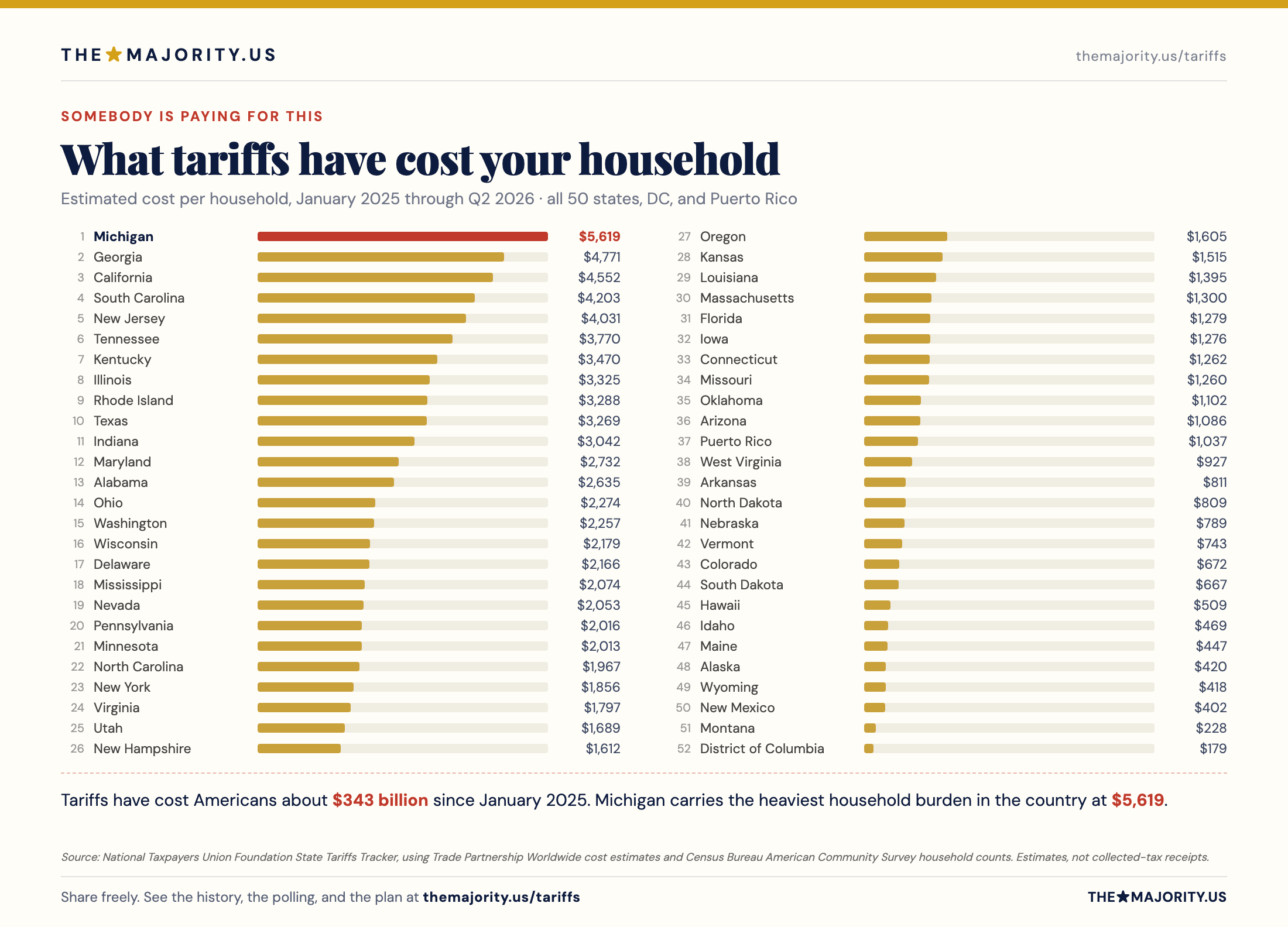
- 1Michigan$5,619
- 2Georgia$4,771
- 3California$4,552
- 4South Carolina$4,203
- 5New Jersey$4,031
- 6Tennessee$3,770
- 7Kentucky$3,470
- 8Illinois$3,325
- 9Rhode Island$3,288
- 10Texas$3,269
- 11Indiana$3,042
- 12Maryland$2,732
Six rules for a trade policy that protects Americans without taxing them.
Across-the-board tariffs on everything from everywhere are not a trade strategy — they are a consumption tax collected at the border and paid at the register. 89% of Americans expect tariffs to raise prices, and 65% of independents say theirs already have. Repeal the blanket rates and start from zero.
Dumping below cost, state-subsidized strategic industries, and countries violating the trade rules they signed all warrant a tariff response. This is where tariffs actually work, and where the public supports them. Keep the tool — stop using it as the whole toolbox.
63% of Americans and 69% of independents favor limiting presidential authority to impose tariffs. Tariffs are taxes, and the Constitution gives the taxing power to Congress. Restore a vote requirement for broad tariffs so trade policy stops swinging every four years.
In 1964 the US answered European duties on American chicken with tariffs on brandy, potato starch, dextrin, and light trucks. Three of those lapsed. The 25% truck tariff is still collected today, 60 years after the poultry dispute that caused it. A tariff with no goal and no expiry stops being a policy and becomes a permanent tax. Each one should name the harm it answers, the outcome that ends it, and a sunset date requiring an affirmative vote to extend.
Most American manufacturers buy imported inputs. The Federal Reserve measured this directly in the 2018–19 tariffs: import protection raised employment 0.4% in the most exposed industries, while higher input costs cut it 2.0% and retaliation another 1.1%. The protection was real and five times smaller than its own side effects. Exempt inputs American producers cannot source domestically at scale.
Tariffs are on this list because they clear 60% in more than one high-quality national poll, with independents at or above that mark. If conditions change — manufacturing gains show up, prices fall — the position has to requalify on polling conducted in 2027–28 or it comes off the platform. The standard applies to us too.
When someone pushes back, send them here.
Didn’t Smoot-Hawley cause the Great Depression?
No — and we're not going to claim it did. The Depression was already underway when Smoot-Hawley was signed in June 1930, and economic historians generally find that collapsing output and incomes drove most of the fall in world trade. Estimates commonly attribute something like a fifth to a quarter of the decline to the tariff and the retaliation it set off.
What it did do is well established. 1,028 economists petitioned Hoover to veto it. Canada and others retaliated. World trade fell roughly two-thirds between 1929 and 1934. It made a severe downturn worse and it taught every country that America would answer trouble by closing its market.
Reagan put the mechanism plainly in 1987: high tariffs invite retaliation, retaliation triggers trade wars, and markets shrink. That's the lesson worth keeping — not a bigger claim the record won't support.
Aren't tariffs how we protect American jobs?
Sometimes — and that's exactly the argument for keeping them targeted. A tariff aimed at a specific abuse, like a foreign competitor selling below cost to take a market, protects the American producer it was designed for. Nobody on this site is arguing otherwise.
A blanket tariff does something different. Most American manufacturers are also importers — of steel, components, chemicals, and machinery. Taxing those inputs raises the cost of building things here, which is the opposite of protection. You end up defending one job by making three others more expensive.
The public reads it the same way. Gallup found only 31% of independents thought tariffs would produce a net financial benefit to the country in the long run, and 62% of Americans overall said tariffs would cost the U.S. more than they generate.
Doesn't the exporting country pay the tariff?
Americans don't think so, and they're the ones checking the receipts. 89% of Americans expect tariffs to result in higher prices, per Gallup. Ipsos put it at 73% expecting higher prices, with only 35% saying tariffs were worth it.
Navigator's January 2026 poll went past expectation to experience: 65% of independents said tariffs had already increased their own costs. That is not a forecast — it is people reporting what they paid.
Isn’t “most Americans oppose tariffs” overstating the case?
Yes — which is why we don't say it. Stanford's Public Pulse reviewed 39 tariff questions across eight nationally representative surveys and found Americans lean negative overall, but that results shift meaningfully with framing. Targeted tariffs — on China, on strategic industries — poll considerably better than across-the-board ones.
So the claim we make is the narrower one the evidence supports: 60% disapprove of substantially increasing tariffs (Pew, January 2026), and Americans favor cutting them over raising them by 35 points (Economist/YouGov, August 2026). Those are specific propositions with specific numbers, not a blanket verdict on the word “tariff.”
Why does this qualify as a Majority issue at all?
Because it passes the test we set. A position doesn't go on this platform because it polls well once. It has to clear 60% in at least two high-quality national polls, and we want independents at or above that mark too.
Tariffs clear it on both counts. Eight separate propositions cross 60% nationally, from four different pollsters. Independents run 63–69% against depending on the question. And Pew's 60% disapproval has been stable since April 2025 rather than spiking with a news cycle.
For 2028, the position has to requalify on polling conducted in 2027–28. If tariffs produce visible manufacturing gains or inflation falls, opinion could move — and if it does, this comes off the list.