AI just made universal healthcare affordable.
Healthcare is economic policy, and AI is making this the moment — cutting the cost of drugs and drug discovery, and multiplying the productivity of doctors, nurses, and hospitals. A 3-step Healthcare Ladder: drug-price caps now, doctor supply next, universal coverage last — funded by cost reallocation, not new spending.
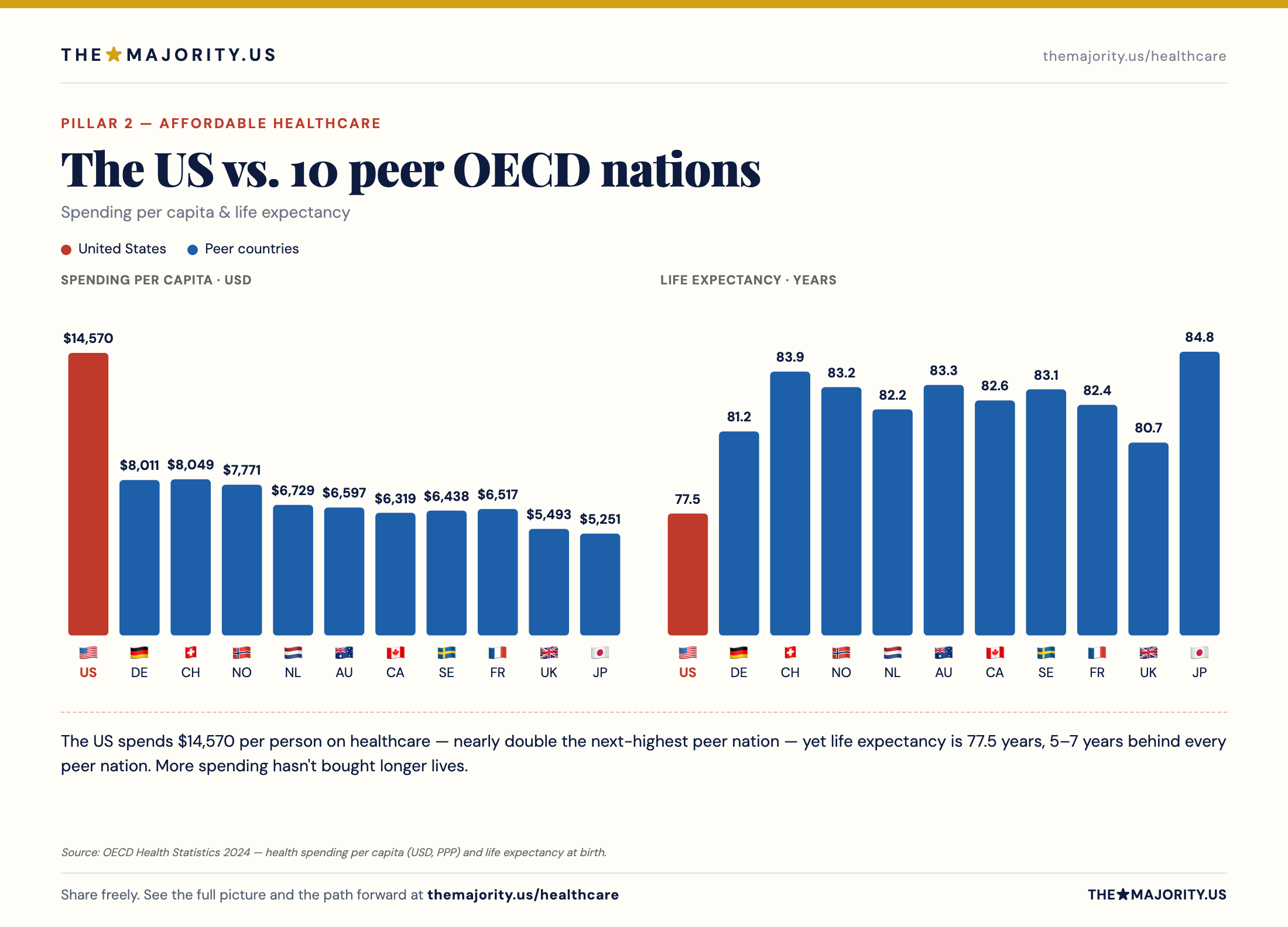
We pay 3× more. We live 6 years less.
An Economic Competitiveness Failure
$5.3 trillion a year — 18% of GDP — grows at 5.8% annually, faster than the US economy itself. US drug prices run 256% of peer nations. 1 in 6 Americans delayed care in 2024 because of cost. This is not a healthcare policy failure. It is an economic competitiveness failure — and every major US rival (Germany, Japan, Canada, South Korea) has already solved it.
Three Steps, One Direction
The Healthcare Ladder is the platform's strategic spine. Each step solves the prerequisite for the next. Step 1 — NOW: Medicare Part D for All, drug costs capped immediately. Step 2 — NEAR (3–7 yrs): build doctor supply — 14,000 new residency slots, debt forgiveness, immigrant physician fast-lane, NP expansion, AI diagnostics. Step 3 — LONG (10–15 yrs): Medicare for All, on a system built to handle it.
Funded by Reallocation, Not New Spending
Funding is not new spending — it is cost reallocation. Three streams: Medicare negotiates drug prices directly ($100B projected 10-year savings); PBM middleman reform ($100B more annually in a $600B market controlled by three firms); and employer premium savings partially redirected to Medicare as a cost swap, not a tax. The net expenditure is designed to grow no faster than CPI.
AI Makes Every Input Cheaper
For the first time in American history, AI is making every input to the system cheaper at the same time: AI-designed drugs are reaching Phase II for $6M instead of $200M, AI scribes recover 55% of physician documentation time, and AI predictive care cuts hospital readmissions up to 70%. The 15-year window is historically unique — the underlying system is getting cheaper while we build the capacity to cover everyone.
| The Healthcare Ladder | Timeline |
|---|---|
| Step 1 — NOW: Medicare Part D for All | Immediate |
| Step 2 — NEAR: Build doctor supply (residencies, NP scope, AI) | 3–7 years |
| Step 3 — LONG: Medicare for All, fully funded | 10–15 years |
| Three Funding Streams | Savings |
|---|---|
| Medicare negotiates drug prices | $100B / 10 yrs (CBO) |
| PBM middleman reform | ~$100B / yr (USC Schaeffer) |
| Employer premium redirect | Cost swap, not tax |
| Key Data | |
|---|---|
| Annual US healthcare spend | $5.3 trillion · 18% of GDP |
| Annual spend growth rate | 5.8% — above GDP |
| US vs. peer-nation drug prices | 256% higher |
| Americans who delayed care (2024) | 1 in 6 |
| Physician shortfall (by 2036) | up to 86,000 physicians |
| PBM market (3 firms, 80% of Rx) | $600B in 2024 |
| AI-designed drug to Phase II | $6M vs. $200M traditional |
| AI predictive-care readmissions | up to 70% reduction |
The Healthcare Ladder — three steps, one direction.
Drug costs capped immediately for all 330M Americans — 83% majority support, including 75% of Republicans. Funded by three redirected streams, not new spending: Medicare negotiates prices directly ($100B saved over 10 years, per CBO), PBM middleman reform (~$100B more annually in a $600B market controlled by three firms), and employer premium savings partially redirected to Medicare as a cost swap. The same insulin that costs $30 at a VA pharmacy costs $98 under Medicare Part D — same drug, same factory, different rule.
The US faces a projected shortfall of up to 86,000 physicians by 2036 — and the bottleneck is residency slots, not medical schools. Five-part fix, 3–7 years: lift the 1997 GME cap (14,000 new Medicare-funded slots), medical-school debt forgiveness for underserved-area service, immigrant physician fast-lane credentialing, nurse-practitioner scope expansion, and AI-assisted diagnostics that extend each physician's reach 3×. You cannot expand universal coverage without the supply to serve it — this builds it first.
Universal coverage is the destination, not the first step. Step 3 arrives after drug prices are negotiated, PBM middlemen reformed, 14,000 new physicians trained, AI has multiplied capacity 2–3×, and hospital readmissions are 50–70% lower. Medicare for All then runs on a system that is structurally cheaper and operationally capable — avoiding the cost spike that has killed every previous universal-coverage attempt.
Who Benefits from Medicare for All
See the path forward →- The 36.2 million small businesses (62.3 million employees) that can't afford healthcare for their employees.
- The 3.4 million farmers who pay 3 times more than farmers in other countries.
- The economy benefits when the government supports affordable healthcare.
Universal healthcare is not socialism, it's economic freedom and capitalism.
JOIN THE MAJORITY →