Climate change isn't a hoax.
For a generation, one party told voters climate change was a hoax — and while they debated, China cornered the market on solar, batteries, and nuclear. It's not a hoax. 99.9% of climate studies agree it's human-caused. The majority never bought the denial. It's time to take the lead back.
Climate change isn't a hoax.
The environment and climate change are a majority issue — not a fringe one. It shows up in the news every week: hotter summers, bigger storms, longer wildfire seasons. The only argument left against it is that the climate has always changed. That's true — and it also ignores the data.
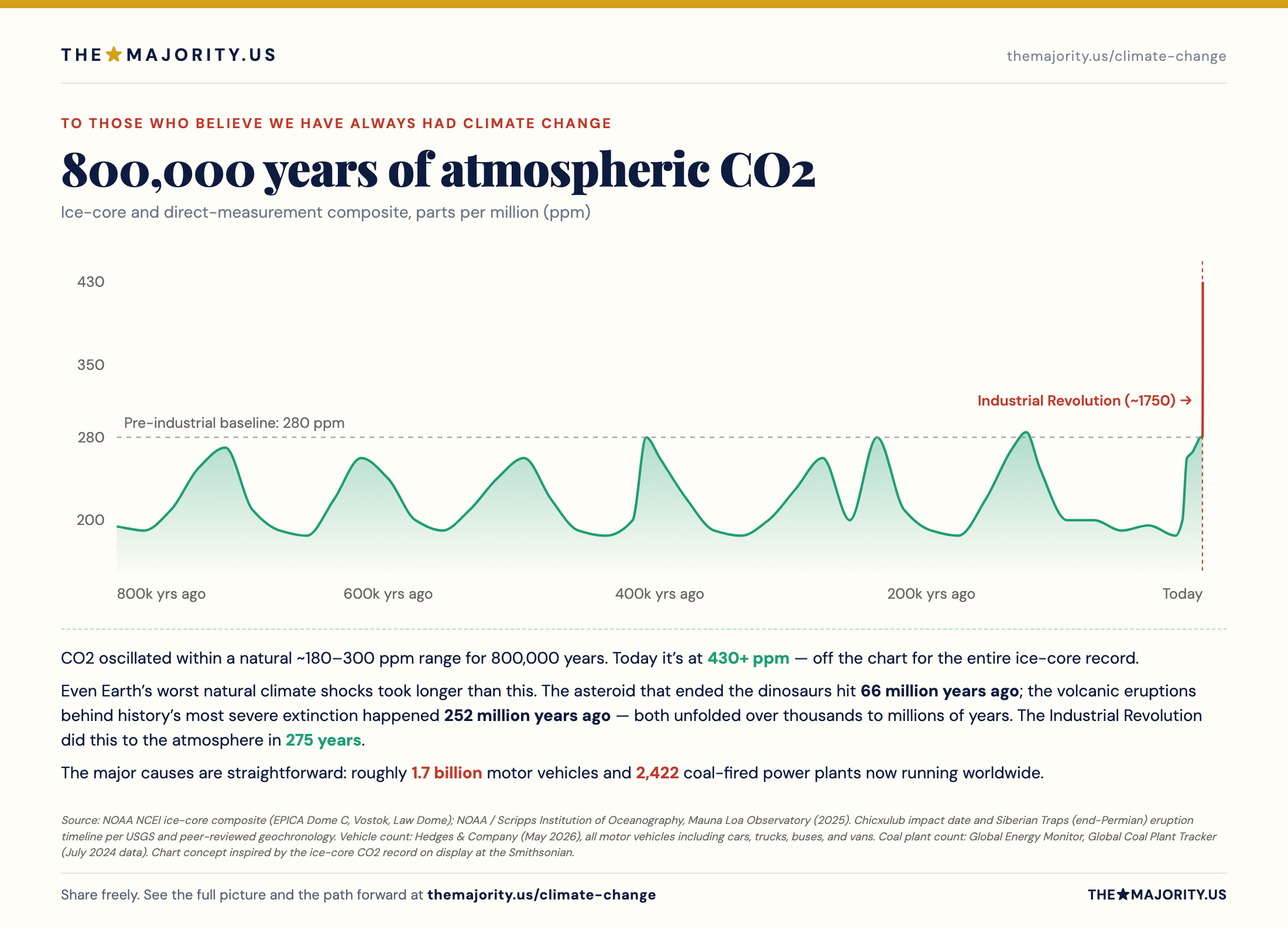
Atmospheric carbon dioxide held steady for 800,000 years before the Industrial Revolution kicked off a rise starting around 1750–1850. It's now above 430 parts per million — the highest level in at least 800,000 years — and still climbing.
This isn't just a climate question — it's an economic one and a public health one. And calling it a hoax hasn't made the problem go away. It's simply handed the next century's energy leadership to China, which now leads the world in nuclear construction, solar and wind manufacturing, electric transportation, and the innovation that comes with all of it.
Market forces, not mandates.
This is not an environmental argument. It's an economic one. Wind power now costs 3.3 cents per kilowatt-hour. Solar costs 4.4 cents. Fossil fuels cost 10 cents. The market already made this decision. The only question is whether American manufacturers and workers benefit from the transition — or whether China does.
China dominates solar panel manufacturing, EV battery supply chains, and wind component production. While America debates, China builds. Every year of delay is manufacturing capacity permanently ceded to a competitor that has no interest in American prosperity.
Natural gas and oil as the bridge — not the enemy, not the target. Nuclear as the backbone. Renewables winning on price. This is not radical — it's arithmetic.
Next-generation reactors make that backbone stronger. The NRC has certified small modular reactor designs whose passive cooling systems remove decay heat without AC or DC power, additional water, or operator action, and adopted a rule letting the required emergency zone be sized to actual dose risk instead of a fixed 10-mile radius. The Energy Department screened 394 coal plant sites and found 80% are strong candidates for next-gen reactors — reusing the transmission lines already there and cutting construction costs 15–35%.
| Metric | Data |
|---|---|
| Wind cost per kWh | 3.3¢ — vs. 10¢ fossil fuels |
| Solar cost per kWh | 4.4¢ — cheapest ever |
| Renewable projects beating fossil | 81% of new projects |
| US residential electricity price (2026) | ~18.3¢/kWh — up from 17.3¢ in 2025 (EIA) |
| Deaths from oil & gas air pollution/yr | 91,000 Americans annually |
| China's EV exports (2025) | 2.6M — more than all US vehicle exports combined |
| US automaker EV writedowns (2025–26) | $47B — Ford, GM, Stellantis combined |
| Offshore wind cancel cost | $928M paid to TotalEnergies |
| STEM grads: China vs US | 6× more engineers/yr |
They didn't skip the energy transition. They won it.
Six moves to take the lead back — and win the energy century.
Every candidate answers on the record: do you accept the science? 97% of actively publishing climate scientists say yes — and so does the weather. 9 in 10 Americans who lived through this year's heat waves, floods, or storms say climate change was a factor. No more "I'm not a scientist" dodges. Denial isn't a policy position — it's how we fell behind.
Natural gas and oil aren't the enemy — they're the bridge, not the target. The NRC has certified small nuclear reactors that self-cool for weeks with zero outside power. DOE found 80% of retiring coal sites are strong candidates for next-gen reactors, reusing the grid connections already there and cutting costs 15–35%.
China exported 2.6 million EVs in 2025 — more than the US exported of any vehicle, of any kind. BYD alone now sells in 119 countries, including Mexico (China's #1 export market in 2025) and Canada under a new 2026 trade deal. Ford, GM, and Stellantis wrote off $47 billion in EV investment after Washington killed the tax credit. Political whiplash didn't kill the transition. It handed it to Beijing.
Next-gen batteries decide who wins everything else on this list. Solid-state batteries promise real gains for EVs — independently verified lab results already show 80%+ capacity retention after 450 cycles, with far less fire risk than today's cells. The Pentagon is already funding solid-state research through DARPA and the Army. Grid storage and the batteries now powering AI data centers run on today's lithium-ion technology — and that market is exploding, from 44.6 GW to a projected 67.5 GW in just one year. All of it depends on a manufacturing base China already controls — 80% of global battery cells. Japan and Korea, not China, lead on solid-state patents, which means the next generation is still up for grabs.
America's grid gets a D+ from civil engineers — down from a C- five years ago, one of the only categories getting worse. In that same five years, China added roughly 1,000 gigawatts of nuclear, solar, and wind combined to its grid — nearly five times the ~210 gigawatts the US added. Over 2,000 gigawatts of new power, mostly wind, solar, and storage, are stuck waiting for a grid connection, and most of it never gets built — only 549 gigawatts has even reached a signed agreement. The fix isn't picking winners: renewables, nuclear, hydro, oil and gas all stay in the mix, with hydrogen coming online for long-duration storage. The only fuel that comes off the grid is coal — already down to 16% of US power, phased out entirely within a decade.
This isn't just about lowering emissions — it's about who sells the world its energy technology for the next fifty years. China already dominates: 80% of global battery manufacturing, most of the world's solar panels, 2.6 million EVs exported in a single year, and more nuclear reactors under construction than any other country. Whoever leads in nuclear, batteries, EVs, solar, wind, and the automation that builds all of it exports the technology, equipment, and expertise the rest of the world has to buy. America invented most of this — the choice now is whether we keep inventing it and let someone else build and sell it, or build and sell it ourselves, including in the technologies nobody's invented yet.
When someone pushes back, send them here.
China pollutes more than we do — why should we act?
They do pollute more, and that isn't in dispute. China is the largest emitter on earth and burns more coal than the rest of the world combined. Granting that changes nothing about what follows.
Because the claim underneath the talking point — that China isn't acting — is simply false. China put $1 trillion into clean energy in 2025, roughly four times the $260 billion it put into fossil fuels and coal power. Clean energy is now 11.4% of China's entire economy, worth $2.1 trillion, and drove more than a third of its GDP growth. As its own country, that sector would be the eighth-largest economy in the world.
They aren't choosing between the two. They're doing both — and we're doing neither. Over the last ten years China added 1,668 gigawatts of wind and solar to America's 275. It has 36 reactors under construction; we have none. It controls more than 80% of global solar manufacturing — including 95% of the silicon wafers every solar panel in the world is built from — and over 70% of EV batteries.
"Why should we act if China won't" was never a climate position. It was a permission slip to stand still — and the bill came due as trillion-dollar industries we no longer own.
Aren’t renewables why my electricity bill keeps going up?
No — and it's mostly not about generation at all. The largest part of your bill is delivery: poles, wires, transformers, storm and wildfire hardening. Utility spending on the distribution system is up 35% since 2019, and the equipment itself rose 50–152% while general inflation ran 29%.
Where generation does drive the bill, the cause is demand exploding while we stopped building. In PJM — the grid serving 67 million Americans — the cost of guaranteeing supply went from $28.92 to $329.17 per megawatt-day in two years. PJM's own market monitor attributes $6.3 billion of the latest $16.4 billion auction to data centers.
Renewables are the cheapest new power available, at 3.3¢ per kilowatt-hour for wind and 4.4¢ for solar against about 10¢ for fossil fuels. Iowa's MidAmerican Energy runs on 88.7% renewable energy and charges roughly 40% below the national average — the fifth-lowest rates of any investor-owned utility in America.
California is the exception people reach for, and it proves the opposite: wildfire costs alone account for as much as 19% of a California power bill. That is the price of climate change arriving, not the price of doing something about it.
Haven't we always had extreme weather?
Yes. Storms, droughts, floods, and heat waves are as old as the planet, and nobody serious argues otherwise. That's not the question. The question is what's different now — and the answer is the sheer scale of what we've added underneath the weather.
There are roughly 5 billion more people alive today than in 1960 — about 3 billion then, more than 8 billion now. Every one of them needs power, heat, food, and goods. Serving that demand takes 1.7 billion motor vehicles on the road and 2,422 coal-fired power plants still running worldwide, plus the grids, factories, and shipping that move it all. None of that existed at this scale in any previous century of extreme weather.
Only about 227 of those 2,422 plants are American — roughly a tenth of the world's total, and down from 518 a decade earlier. That's the whole point. The demand is global and it isn't going away — somebody is going to build the power that meets it. Switching America off by itself doesn't change the air. Building what the rest of the world buys next does.
The atmosphere kept the receipt. For 800,000 years CO2 stayed inside a natural 180–300 ppm band. It's now past 430 ppm — and it got there in about 275 years, not the thousands of years every natural shift took.
That's also why the extremes hit harder rather than just more often. A warmer atmosphere holds roughly 7% more moisture per degree Celsius, so the same storm arrives carrying more water to dump. We've always had weather. We haven't always had this much of us changing the air it forms in.
Is solar stealing valuable farmland?
No. Solar covers just 0.14% of US farmland — about 1.25 million of the nation's 879 million farmland acres.
Farmers who lease to solar aren't losing their land to it — they're often making more from it. Solar leases pay $500–$1,000+ per acre per year, three to seven times the roughly $146 an acre that cropland typically rents for, with none of the weather or input-cost risk.
Many sites do both at once: over 113,000 sheep now graze under solar panels across 30 states, and pollinator habitat planted at solar sites has tripled local insect populations.
Aren’t small nuclear reactors too expensive and risky to build?
The safety case is proven; the cost case is still being built. The one U.S. project with a firm price tag — a small-reactor plant planned for Idaho — saw its projected cost balloon from $3 billion to $9.3 billion before it was cancelled in 2023. That's a real data point, not a reason to give up on nuclear — it's why the smart move is building on the retiring coal sites that already have the transmission lines, cooling systems, and skilled workforce in place. A federal study found that alone cuts costs 15–35%.
On safety, the record is stronger. The Nuclear Regulatory Commission has certified a small reactor design whose passive cooling systems remove decay heat without AC or DC power, additional water, or operator action, and adopted a rule letting the required emergency zone be sized to the actual dose risk instead of a fixed 10-mile radius. Today, one small reactor is genuinely under construction — at Oak Ridge, TN — with several more in the federal licensing pipeline.
What about fusion — is that the real answer?
Fusion — the reaction that powers the sun — cleared a real milestone in December 2022, when a federal lab got more energy out of a fusion reaction than went into the fuel, and has beaten that result several times since.
It's not a near-term fix. That lab experiment fires about once a day; a power plant needs to fire roughly ten times a second. Even ITER, the world's largest fusion project, doesn't expect full fusion power before the 2040s, and independent physicists — not company press releases — put commercial fusion on a similar timeline. That's not a reason to ignore it — it's the one energy source with no meltdown risk and virtually unlimited fuel. Worth serious, sustained federal investment now, so the country that cracks it first isn't China.